
Districting Proposal Information
March 2026
This video from the Districting Strategy Team outlines a redistricting proposal for the Tennessee-Western Kentucky Conference.
Frequently asked questions with answers are posted below it on this page.
If you have further questions, please contact the team at redistricting.questions@twkumc.org.
Frequently Asked Questions
Click on the boxes below for frequently asked questions with answers!
General Questions
How does the creation of new districts affect me?
For most churches and members, day-to-day ministry will remain the same. The goal of the new structure is to better support local churches in making disciples of Jesus Christ while strengthening connectionalism and communication across the conference.
Which of the three districts will my church be in? How many churches and clergy are in each district?
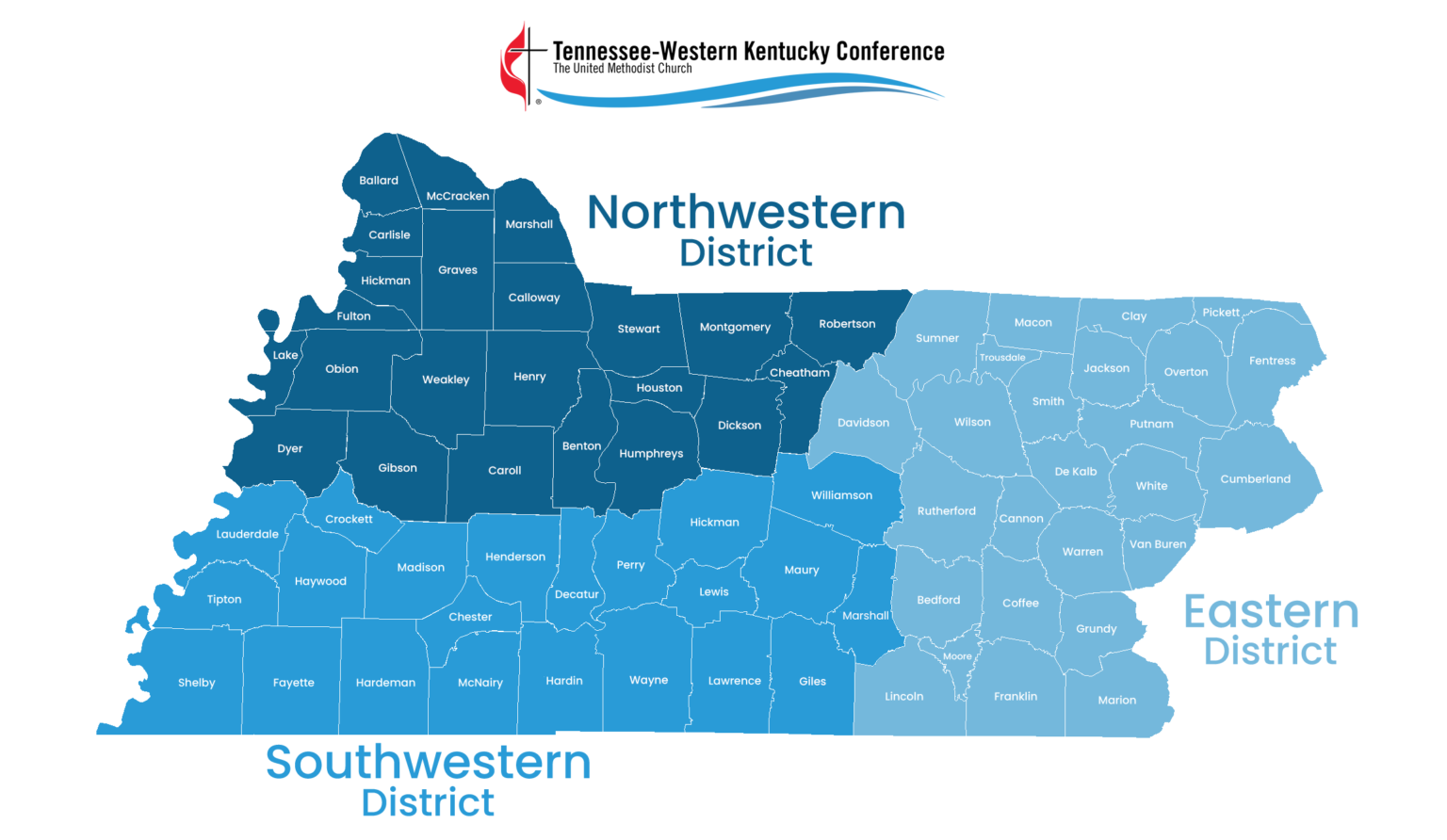
The conference will consist of three districts: Northwestern District, Southwestern District, and Eastern District. It is the responsibility of the bishop and cabinet to draw final boundaries and assignments. A proposed map is available, with district lines following county lines. For charges that have churches in multiple counties that cross district lines, the charge will follow the lead church in determining district placement.
Based on the proposed map, three proposed regions reflect broadly equitable distribution while respecting natural geographic and community boundaries.
Southwestern District
Churches
176
Multi-Church Charges
47
Single Charges
86
Counties
22
Clergy
146
Northwestern District
Churches
152
Multi-Church Charges
41
Single Charges
74
Counties
23
Clergy
112
Eastern District
Churches
170
Multi-Church Charges
25
Single Charges
125
Counties
29
Clergy
169
Total
Churches
498
Multi-Church Charges
113
Single Charges
285
Counties
64
Clergy
427
Will my pastor change?
The process of pastoral appointments remains the same. Pastoral appointments are made through the consultative process of the bishop and cabinet. Appointment projections for the 2026-2027 conference year will be shared after Easter and finalized at the Annual Conference.
When do the new district lines take effect?
The Annual Conference will vote in June on the number of districts. If approved, the structure would become official on July 1, 2026, with full district organization, including the makeup of district committees, occurring in the months following.
If I currently have a strong relationship with my district superintendent, will I lose that?
The new structure is designed to strengthen relationships by adding Associates to the District Superintendent (A2Ds) who provide relational presence and support to clergy and churches.
How will Charge Conferences work?
Charge Conferences will continue to occur annually, and, as now, the Charge Conference will be presided over by an elder, either the District Superintendent or another elder they appoint, which could include the Associate to the District Superintendent. The district staff team will communicate that plan to each congregation.
How does the creation of new districts affect me?
For most churches and members, day-to-day ministry will remain the same. The goal of the new structure is to better support local churches in making disciples of Jesus Christ while strengthening connectionalism and communication across the conference.
Was there ever a consideration to have not 3 but 4 districts? If not, why not? Some of the geographical areas are huge.
We considered 3, 4, 5, and 6 districts. All were analyzed based on workload, communication, efficiency, and cost. The three district model with a team leadership approach appears to be the best overall.
Which of the three districts will my church be in? How many churches and clergy are in each district?
The conference will consist of three districts: Northwestern District, Southwestern District, and Eastern District. It is the responsibility of the bishop and cabinet to draw final boundaries and assignments. A proposed map is available, with district lines following county lines. For charges that have churches in multiple counties that cross district lines, the charge will follow the lead church in determining district placement.
Based on the proposed map, three proposed regions reflect broadly equitable distribution while respecting natural geographic and community boundaries.
The chart below includes pastors serving in local churches, no matter their Conference Relationship. Extension clergy, clergy on leave, and retired clergy not actively serving a church are not included
District | Churches | Total Number of Charges | Counties | Clergy | |
Southwestern District | 176 |
| 86 | 22 | 146 |
Northwestern District | 152 | 74 | 23 | 112 | |
Eastern District | 170 | 125 | 29 | 169 | |
TOTAL | 498 | 285 | 64 | 427 |
Will my pastor change?
The process of pastoral appointments remains the same. Pastoral appointments are made through the consultative process of the bishop and cabinet. Appointment projections for the 2026-2027 conference year will be shared after Easter and finalized at the Annual Conference.
When do the new district lines take effect?
The Annual Conference will vote in June on the number of districts. The outlined district structure would begin July 1, 2026, with a thoughtful, phased implementation continuing in the following months up to 2027. Some things will be clear as we begin (assignments of DS, A2D, DA, and local churches), while some will be developed during the remainder of 2026 (e.g., committees).
If I currently have a strong relationship with my district superintendent, will I lose that?
The new structure is designed to strengthen relationships by adding Associates to the District Superintendent (A2Ds) who provide relational presence and support to clergy and churches.
How will Charge Conferences work?
The District Superintendent shall preside at the meetings of the charge conference or may designate a clergy member in full connection to preside (¶246.5). Charge Conference schedules and plans will be communicated by the District office to each congregation on an annual basis.
About the Districting Strategy Team
How was the Districting Strategy Team selected, and who are its members?
The Cabinet is tasked with the responsibility to create districts, once a number of districts is approved by the annual conference. To invest in deep discernment, the cabinet asked the TWK Connectional Table for input on how best to discern. The CT and Cabinet agreed to enlist a Strategy team to do a deep dive. The team was selected and affirmed by the Bishop, Connectional Table, and the cabinet. The members are Carlisle Jones, Janice McCallen, Jefferson Furtado, Chris Grosson, Mark Hagewood, Diantha McLeod, Nancy Johnston Varden, Rickey Wade, and Vona Wilson.
Connection to United Methodist Polity
What does the Book of Discipline require regarding redistricting, and how does this plan comply?
The proposal complies with the Book of Discipline. District Superintendents hold responsibilities that cannot be delegated, including supervision and discipline of clergy and service on committees such as the district Committee on Ministry and District Board of Church Location and Building. The plan also reflects a Judicial Council ruling that there can only be one District Superintendent per district.
Acronym Breakdown
DS: District Superintendent
The clergy leader is responsible for supervising clergy, handling crises that require DS authority, and serving on key district committees.
DA: District Administrator
Administrative staff who help manage communication, coordination, and operational needs for the district.
A2D: Associate to the District Superintendent
A clergy leader who works quarter-time alongside the DS to support churches and clergy through relational connection and leadership, and sits on the appointive cabinet. (Please note that this position title is “associate,” whereas the A2B is the Assistant to the Bishop.)
Associate to the District Superintendent Role (A2D)
How are A2Ds selected or appointed?
Elders are appointed to these positions by the bishop and the cabinet.
How many A2Ds will be allocated to each district?
The current staffing plan is to have 4 in the Eastern District, 3 in the Southwestern District, and 3 in the Northwestern District.
What metrics will be used to determine the number of A2Ds in each District?
This is a great question! This new model allows us to adjust staffing up or down as needs change in each district. Some of the factors considered as we begin include: the context of the churches within an area; geography; access to resources; specific ministry needs within the district; density of clergy, population, and community resources.
What does ‘quarter-time’ look like in practice?
Quarter-time A2Ds will also serve in a local church, extension ministry or in retirement while assisting the District Superintendent in district leadership.
How will we know who to talk to about what? In other words, what topics do we take to the A2D, and what topics do we take to the DS?
“Clarity and Communication” is one of the “big rocks” integrated into this new districting model. We heard loud and clear that local churches need to know who to call. As the new districts are established in July, one of the early decisions and organizational priorities will be to communicate with the local churches about who to call. It will be clear, simple, and easily accessible for everyone.
How will these Associates to the DS’s have time to help us or meet with us if they are also serving a church?
This is a great question! For the past three years, we have been using a variety of “Cohort DS” models to experiment with different ways of providing District coverage. The Elders serving in those roles have learned a lot from their experiences. We are taking those best practices and bringing them forward as we launch this new model. Associates to the District Superintendent (A2D’s) will have a specific group of churches that is manageable and allows them to deepen connection. This has been very effective with the previous cohort model. We will have the nimbleness to create a variety of ways to meet the needs of the local church.
Is it wise to continue the practice of having pastors under appointment serving on the cabinet? This seems like a conflict of interest. I would much rather put my trust in a DS who has heard all sides and brings all sides to the table. That seems less biased than having someone who is in the middle of it.
Another great question. Developing trusting, unbiased, and healthy relationships is a critical piece of Superintendency, leadership at any level, and certainly for the work of a Bishop and Cabinet. This question speaks to the importance of careful, intentional, and thoughtful consideration of any situation that needs to be shared within the Cabinet team. A few things are being practiced already, and others are being added as we step into this new model:
The Cabinet team already practices using a covenant. Bishop Graves leads us in reviewing that covenant on a regular basis. We hold ourselves accountable for practicing it. And it changes conversations. As the Proverb says, “Iron sharpens iron and so one friend sharpens another.” – Proverbs 27:17
In late June, these new district leadership teams will participate in a new orientation and training that will include leadership practices that develop trust, healthy relationships, and team integrity. Teams will work with a professional coach throughout the first year to help them establish good practices. One of the “big rocks” in this new model is “excellence in function”. Leadership is a key function, and we want it to be the best it can be. That takes intentional work on a regular basis.
The Cabinet uses other practices, including: filtering questions before final decision making; 3 Practice circles for strengthening our listening; and contemplative practice for discernment. We seek clarity until it comes, and when that takes a long time, we accept the need for waiting.
The “big rock” of “Communication and Clarity” is something we will be watching all the time as we enter this new model. Feedback loops will help us know how it’s going.
How will the DS and A2Ds know clergy well enough (with such large districts and the A2Ds also serving churches) when it comes to appointment season?
Being prepared for the appointive season is a significant priority in the new model. We will be constantly assessing how this new model is (or is not) allowing us to know clergy and congregations well enough to engage in the appointive process. One of the most exciting things about the new model is that it allows us to be flexible, according to the needs of a particular district. We can and will adjust staffing as we learn what works best.
How are A2Ds compensated?
The conference budget will provide funds for the A2D’s work. In most cases, these funds will be sent to the local church where the A2D is serving to be added to their regular payroll.
Financial Questions
Where does the figure $450,000 in savings come from?
The bulk of the savings comes from salaries and benefits. The proposed model reduces the cabinet human resources costs (including full and part-time elders and full-time administrators) from 15.25 full-time equivalents to 11.5 full-time equivalents. There will be additional savings from having fewer district budgets.
Will each District be charged with paying for the A2Ds?
No. The position is held at the district level, but the A2Ds are conference employees, just like the District Superintendents and District Administrative Assistants. These positions are paid through the conference office as part of the TWK Operating Budget.
What is the projected salary for the three clergy members who will be named by the Bishop and Cabinet as district superintendents?
Full-time District Superintendents will make the same salary as they currently make for the second half of 2026. The budget for 2027 has not been finalized yet, but it will likely include a small cost-of-living increase based on the current salary.
What is the projected total cost of the A2Ds?
The A2D positions will be compensated at ¼ the salary of a full-time District Superintendent. For the 2026-2027 conference year, the bishop is projecting 10 A2Ds. This plan gives the conference and bishop great latitude to adjust the number of A2Ds up or down in future years based on need.
Regarding the two district administrative assistant (DA) positions for each of the three districts, how are those salaries determined? Is there a formula or salary schedule/scale?
The Human Resources Committee sets salaries when employees are hired and regularly reviews salaries as part of their budget requisition process each year.
What is it projected to cost with all the staff compared to now? What are the financial reasons for structuring in the way that is presented?
Our current structure has 6 full-time District Superintendents, 5 quarter-time Cohort District Superintendents, and 8 full-time District Administrative Assistants. The salary cost for these positions is approximately $1.449 million.
The proposed structure will have 3 full-time District Superintendents, 10 quarter-time Associates to the District Superintendents, and 6 full-time District Administrative Assistants. The salary cost for these positions will be approximately $1.096 million, reducing salary costs by $353,000.
In addition, we anticipate a lower cabinet meeting budget and district budgets to reduce costs by an additional $150,000.
This half a million dollars in savings helps the conference propose a balanced budget for 2027.
Will the savings be redirected to local church support or absorbed into the conference budget?
Expenses for current conference ministries and operations exceed connectional commitment income; therefore, savings realized through this plan will reduce the conference’s need to rely on reserve earnings and will help ensure the long-term sustainability of the conference.
If an elder conducts a charge conference, who is not a DS and not an A2Ds, will that individual be compensated in any way – expenses, stipend, etc.?
Having elders other than an DS conduct charge conferences is not new to this plan; we already do this as allowed in the Book of Discipline. The current Book of Discipline clarifies who can preside at a Charge Conference in ¶246.5, as a “clergy member in full connection.” It has not been our practice in the Tennessee-Western Kentucky Conference to compensate for conducting charge conferences, and there is no plan to start doing that. Serving the conference and denomination is part of the work of ordained clergy.
Annual Conference Vote
What happens if the Annual Conference votes for a different number than the three proposed by the Districting Strategy Team?
If the conference votes differently regarding the number of districts, the bishop and cabinet would draw new district boundaries and discern how to staff those districts within the approved budget.
What’s the voting threshold?
The resolution to change the number of districts must pass by a simple majority, i.e. 50% plus one vote.
What role does the laity have in drawing or reviewing boundary lines?
The Annual Conference body, which includes clergy and lay delegates, votes on the number of districts. According to the Book of Discipline, the bishop and cabinet draw the district boundaries. The Districting Strategy Team (which includes cabinet members) also worked to propose boundary lines as part of their discernment. The laity are not only on that team but were also part of the listening conversations/research.
Staffing and Transition Concerns
What happens to current district superintendents who won’t continue in that role?
Elders who serve as District Superintendents are part of the annual appointive process.
What are the specific duties of each member of the team? How will the congregational members of each church be included?
The specific job descriptions for each team member are being finalized this month. After July 1, the teams will communicate directly with congregations as they build the new district relationship with them.
Why are people being appointed to positions prior to the conference vote on the issue?
The appointment calendar mandates that we make our best projections. If the annual conference approves a different plan, we will adjust the appointments. Remember, no appointment is final until set at the annual conference.
What were/are the specific failings of the cohort model? What did they not do they were supposed to do, and what did they do that they were not supposed to do? What specific safeguards, guidelines, regulations, or rules are in place in the new plan to prevent those failings from recurring in the new model?
The Cohort model was not a failure at all. It actually informed us about this new iteration. Through the cohort model, we learned the capacity of an Elder serving a local church and providing connectional leadership (Cohort DS) to a certain number of churches.
We learned how ready churches were to collaborate and think together when grouped in manageable numbers and deeper relationships. We discovered that Elders who are serving in the local church bring a clear voice to Cabinet discussions, helping us keep the local church needs and contexts at the forefront of our work.
The next iteration of district leadership brings this learning into the entirety of our Conference. It gives all of our pastors and churches an opportunity to experience a fresh approach to district experiences. It brings the local church much closer to the Cabinet and other Connection Ministry resources. The cohort model prepared us for the future, and now we are ready to act.
If each district will have 2 administrative assistants and 3-4 A2Ds, why not just combine the assistant salaries into another full-time DS and split it up into 6 districts?
Personnel were not the only factor in deciding the number of districts. The Book of Discipline has certain requirements for each district, including that each district have a District Committee on Ministry and a Committee on Superintendency.
The smaller number of districts keeps us from overtaxing our volunteers by having full dCOMs in more, smaller districts. In addition, three districts with multiple A2Ds each provide significant flexibility for future staffing iterations without changing the number of districts in the near future.
What is the best way to propose adding lay persons to the TWK Conference Team. How may I best recommend having assistant Lay Leaders one for each of the A2D’s?
Sending your idea to the redistricting implementation team at redistricting.questions@twkumc.org is the best way to propose additions to the plan. Details like that are up to the bishop and the cabinet after the number of districts is affirmed by the annual conference. This Redistricting Implementation team will be involved with that, and the questions and suggestions like yours will be considered. This process starts after the annual conference and will likely continue until the end of 2026.
What’s the staffing transition timeline — phased or immediate?
The structure will move through the normal appointment process, with projections shared after Easter and finalized at Annual Conference.
Who will manage all the details of setting up new districts?
The Bishop has asked a team of staff to manage the implementation of the new district setup: Melinda Britt, Brandy Galbraith, Chris Grosson, Alice Grunau, Mark Hagewood, Amy Hurd, Courtney Lawson, Rickey Wade, and Vona Wilson. They will work with staff and ministry teams through 2026 so that the districts are fully set up by January 2027.
Has clergy engagement been considered as our districts grow in scope? How do we foster communication and camaraderie among clergy colleagues in more times and places throughout the Conference rather than just at Annual Conference?
Teams are already considering how we might create more spaces for TWK clergy to connect and build relationships with one another outside of more formal District Gatherings and Annual Conference. The conference Mental Health & Well-Being Guide Team, the new Connection Guide Team, Camp & Retreat staff, the Board of Ordained Ministry, and leaders from the Clergy Orders are already discussing possibilities.
Associate to District Superintendent
District Identity
How will we have district meetings? Will those be subdistrict meetings with our assistant district superintendent, and or full district meetings led by our district superintendent?
Each District Leadership Team will work together to decide what works best for the district. These are the types of conversations and decisions that will take place in the weeks and months following Annual Conference. The “big rocks” of deepening connection within the district will be a driver for whatever approach is used.
How will clergy peer groups or clusters be organized?
These relational groups will be organized by the district leadership teams after the districts are established during the remainder of 2026.
How will D-Com relate to the new structure?
DCOMs will continue to function in the district in the same way they currently do now.
What is changing with the current cohort system?
The proposal is not a continuation of the current cohort system; instead, it introduces a new team approach to district leadership that includes a DS, 2 DAs, 3 or 4 A2Ds, and a Lay Leader.
Do we know yet where each district would be headquartered?
Decisions on district headquarters have not yet been made, but the Administrative Strategy Team has been charged with developing a plan for this. This team will consult with Trustees, Human Resources Committee, and the Cabinet on this plan.
What about groups like United Women in Faith, who like to attend district gatherings? This would mean a much longer drive.
This may be an item that the district team will work out as they begin their work. There may also be sub-district events.